
Publications


Introduction: Teacher training in EMI may pose certain challenges in countries where rates of English language proficiency are not high. This study examined the perspective of pre-service English teachers and teacher educators on effective English as a Medium of Instruction (EMI) teaching practices, the challenges involved, and the immediate needs of teacher education in Ecuador. Methodology: In this mixed-method study, the researcher collected data from 123 pre-service teachers through a quantitative survey on their preferred teaching practices and conducted in-depth interviews with five teacher educators at a teacher training university to explore challenges, needs, and best practices, as well as to identify points of alignment and areas requiring adaptation. Results and discussion: The findings indicate that both groups of participants value lecturing and Active Learning (AL) strategies in EMI teacher training. Specifically, lectures are valued for their time efficiency and for simplifying complex concepts for all participants, and AL is praised for fostering engagement, critical thinking, and knowledge application. However, implementing these practices is not without challenges, as lectures pose challenges to student engagement and knowledge retention, and AL is criticized for uneven participation, time inefficiency, student fatigue, and limitations in addressing complex subjects. Moreover, suitable EMI teaching materials that align with learners’ proficiency levels are scarce. Conclusions: Effective teaching practices to respond to the challenges identified in this study involve combining lectures and active learning to minimize the obstacles and maximize the benefits of each method of instruction. Immediate needs include developing suitable materials that are easy to read and integrating active learning techniques with traditional lectures.
Speaking Bridge
Textbook, Published in 2025
Madison Publishing
Most international exams, such as TOEFL and IELTS, require candidates to speak fluently
and accurately about unfamiliar topics. Developing this skill requires not only practice and
thinking time but also consistent corrective feedback to help learners refine their accuracy
and reduce hesitation. Without this preparation, many students face difficulties in the
exam and fall short of their desired scores.
Speaking Bridge is a bridging workbook designed to close this gap. It gives learners the
chance to practice speaking about unfamiliar topics in a structured way, focusing on both
fluency and accuracy. The workbook can be used flexibly — either in a classroom setting
under the guidance of a teacher or independently by motivated learners.
The Speaking Bridge approach works in three stages:
- Preparation before class or practice: learners prepare ideas on unfamiliar discussion
topics, which activates their passive linguistic knowledge and helps them retrieve
complex grammar they already know but rarely use. - Speaking in a stress-free environment: learners engage in debates or discussions where
they can express their ideas without pressure, practicing fluency while building
confidence. - Corrective feedback: learners receive feedback during or after their speaking tasks,
which helps them notice and overcome errors and gradually improve their speaking
accuracy.
Through this process, Speaking Bridge offers learners a systematic way to practice the exact
type of speaking skills required in international exams — fluency, accuracy, and the ability
to communicate clearly on unfamiliar topics.
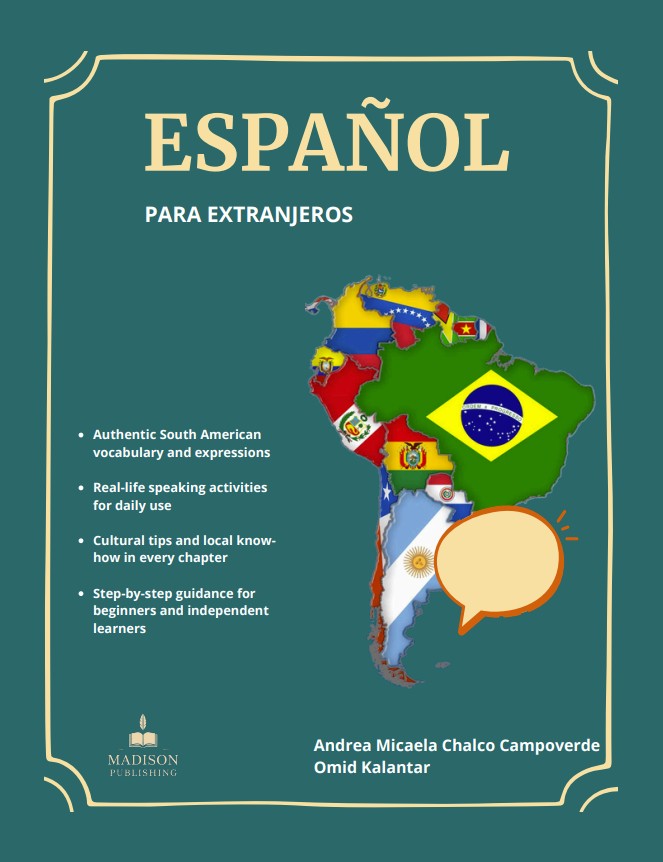
Español para Extranjeros
Textbook, Published in 2025
Madison Publishing
Are you ready to live, work, or travel in South America? With Spanish Advantage, you’ll go
beyond textbook grammar and unlock the real Spanish spoken across the continent.
Unlike many courses that focus on European Spanish, this book brings you the authentic
language, expressions, and cultural insights from countries like Ecuador, Colombia, Peru,
Chile, and Argentina.
Grounded in a communicative approach, Spanish Advantage helps you practice Spanish as
it’s truly spoken — through dialogues, role-plays, and everyday situations. You’ll not only
learn the words but also understand the culture, traditions, and social cues that make
communication smooth and natural.
- Authentic South American vocabulary and expressions
- Real-life speaking activities for daily use
- Cultural tips and local know-how in every chapter
- Step-by-step guidance for beginners and independent learners
Whether you’re preparing to settle in South America, building connections with locals, or
simply aiming for confident fluency, Spanish Advantage gives you the tools you need to
speak naturally, live fully, and thrive abroad
Book Review, Published in 2025
Stories of Mentoring Teacher-Research is a publication by the IATEFL Research Special Interest Group (ReSIG) in collaboration with MenTRnet, a network dedicated to mentoring teacher-researchers. This book brings together 20 powerful narratives from mentors all over the world who voluntarily supported their fellow teachers to conduct research in their classrooms. What makes this collection truly remarkable is its humble storytelling style that follows a bottom-up, practice-oriented approach without placing anyone on a pedestal. If there is a hero in these stories, it’s not the mentor, but the teachers themselves. The use of stories as opposed to opting for an academic genre is intriguing in itself and it appears that the collective of the co-authors and the co-editors unanimously chose this style for a reason. In the words of the editors: ‘The narrators of the stories in this book emphasize their own emotions and actions, and we have tried to help them configure these into a believable story in a well-described local context’ (p. 6).
Research Article, Published in 2024
SCOPUS Q1
The present study examined factors affecting shyness in EFL classrooms. To this end, a sample of 124 students majoring in TEFL at Universidad Nacional de Educación in Ecuador was selected to respond to a standardized Shyness Scale (SS) and a Shyness Factors Questionnaire (SFQ). Employing a descriptive research design, the researcher used Descriptive Statistics to analyze the collected data using SPSS. The findings indicate that 65% of the participants are shy and battle with negative emotions such as embarrassment, anxiety, low self-confidence, fear of making mistakes, and fear of being judged when speaking in EFL classrooms. These feelings were found to be intensified by negative classroom experiences, such as peer ridicule and judgmental attitudes during their formative years, which lingered into their adulthood as well as present cultural and environmental factors including limited social exposure and high academic expectations from their families. The results of this study highlight the importance of student welfare and the impact of bullying and verbal abuse on shy EFL learners.
Book Review, Published in 2024
As an educator, my primary focus has always centered on research, teaching practices, and techniques in teaching English as a foreign language. However, reading The Future of English: Global Perspectives opened my eyes to a new world concerning the future of English, learning, and teaching. Will the pursuit of English language learning continue to hold its significance, or might it wane as other languages ascend in prominence? This is one of the eight questions posed in this book. These inquiries bear particular weight in a post-pandemic world where political tensions, conflicts, and the rise of artificial intelligence are the hot topics of the day. Commissioned by the British Council and supported by its global reach, the authors of this book have assembled experts from around the world to discuss critical issues such as the driving forces behind the demand for learning English language and the relevance of English teachers in the age of technology and artificial intelligence (AI). Their collective insights provide intriguing discussions and points of view about the future, and the authors have done a fantastic job in drawing conclusions from those discussions and providing answers to the posed questions.
Research Article, Published in 2024

zone out
Textbook, Published in 2021
download Sample chapters
Due to the importance of fluency and accuracy in the speaking part of international exams such as TOEFL and IELTS, candidates need to be able to speak easily and without error to achieve a high score. However, most students demonstrate hesitation, grammatical inaccuracies, and low levels of fluency and accuracy when they sign up for exam preparation courses, which may lead to undesired exam results. To avoid this, a bridging course to fill the gap and enhance candidates’ fluency and accuracy before taking preparation classes or the exam seems essential.
Zone Out is a bridging course that focuses on improving candidates’ fluency and accuracy using corrective feedback methods. It is a framework in which teachers are equipped with the tools and guidelines necessary to help students speak fluently, accurately, and without hesitation. The Zone Out approach encourages students to prepare and plan for class discussions before the class, engage in exciting debates on controversial topics during the class, and receive corrective feedback during and at the end of the class to improve their fluency and accuracy in a stress-free environment.
The Zone Out approach works in three stages: active planning before the class, reaping the benefits of zoning out and speaking in a stress-free environment during the class, and receiving corrective feedback at the end of the class. By planning and preparing for class discussions, learners retrieve passive information from their long-term memory to express their opinion in class. Such preparation activates students’ passive linguistic knowledge and the complex grammar they have always known but never used in their speaking. During the class, teachers lead an exciting discussion to make sure students feel comfortable to speak and express their ideas, and finally, corrective feedback is provided at the end of the class to help students overcome their speaking errors and further enhance their speaking skills.

ESP Needs Analysis for basketball professionals
Master's thesis, published in 2018
download thesis
This study investigated the English for Specific Purposes (ESP) needs of the Iranian basketball community. For this purpose, three groups of basketball professionals including players, referees, and coaches were surveyed using three distinct survey questionnaires. The results indicated that all groups highly value the importance of English fluency for professional development and desire instruction in all language skills. However, coaches prefer technical English functions, and referees place more importance on reading and writing. Finally, the results of this study highlight the need for a specialized ESP courses for this community.